
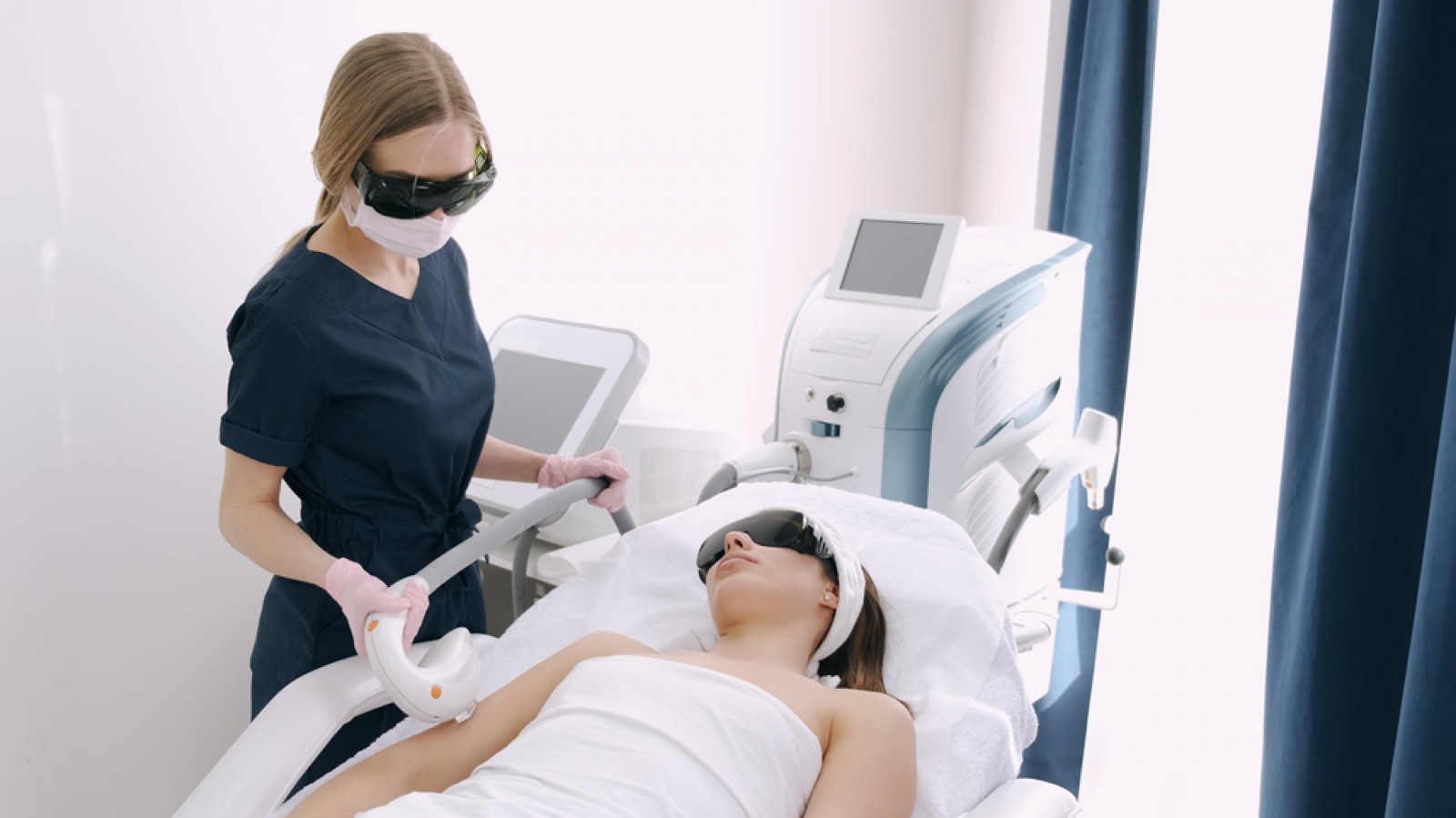
Alexandrite Laser: The Technology
What light at 755nm does exactly, why the Alexandrite is considered the "gold standard" for Mediterranean skin, and how it compares with every other technology — explained so that you really understand it.
How it works: selective photothermolysis in plain words
The Alexandrite laser emits light at 755nm — a wavelength that is strongly absorbed by melanin, the pigment that gives hair its dark colour. The light energy travels along the hair to the root, is converted into heat and deactivates the follicle — the "factory" that produces the hair. The surrounding skin, with far less melanin, is left unaffected.
This principle is called selective photothermolysis and it is the reason why the laser works better the greater the contrast between skin and hair: light skin with dark hair is the ideal combination — that is, the classic Mediterranean profile.
Alexandrite vs other technologies
Every technology has its role — the choice depends mainly on the phototype of the skin and the characteristics of the hair:
| Technology | Wavelength | Ideal for | Comment |
|---|---|---|---|
| Alexandrite | 755nm | Phototypes I–III (Mediterranean skin) | High absorption in melanin — fast, effective sessions |
| Diode | 800–810nm | Phototypes II–IV | Versatile, with strong evidence — slightly deeper penetration |
| Nd:YAG | 1064nm | Dark phototypes V–VI | Safe on dark skin, with lower absorption in melanin |
| IPL (pulsed light) | broad spectrum | — | Not a laser — less targeted, weaker evidence on how long it lasts |
Cooling & comfort
Modern Alexandrite handpieces combine every pulse with simultaneous cooling of the epidermis. The result: the skin is protected, the sensation is limited to a momentary "pinch with heat", and the sessions move quickly even over large areas.
Safety & possible side effects
- ✓Common & transient: mild redness and a feeling of warm skin for a few hours.
- ✓Rare & avoidable: temporary changes in pigmentation — almost always linked to wrong settings. That is why the treatment is carried out only by trained staff, with a proper medical history.
- ✓Contraindications: pregnancy (as a precaution), active skin conditions in the area, photosensitising medicines.
The operator counts as much as the machine
The same laser in different hands gives different results: the energy per pulse, its duration and the size of the handpiece are set at each session on the basis of the phototype, the area and the response the previous time. At BFI every operator is certified on this particular platform and works with medical protocols — which is why our results are consistent and side effects rare.
What the studies say
- Eremia S. et al., Dermatologic Surgery (2001): a prospective study with a 755nm Alexandrite laser recorded a mean hair reduction of ~89% at 18 months after a series of sessions on the legs, bikini and underarms.
See the publication on PubMed ↗ - Haedersdal M. & Gøtzsche P., Copenhagen University Hospital — Cochrane Review (2006): the systematic review concluded that the Alexandrite and the diode laser have the strongest scientific evidence of effectiveness, with a mean short-term reduction of ~50% at 6 months.
See the review in the Cochrane Library ↗ - Gan S.D. & Graber E.M., Boston University School of Medicine — Dermatologic Surgery (2013): a review of safety and effectiveness: high satisfaction rates, with side effects that are as a rule mild and transient when the treatment is carried out by trained staff.
See the publication on PubMed ↗ - Davoudi S.M. et al., Wellman Center, Massachusetts General Hospital / Harvard — Archives of Dermatology (2008): a randomised comparison of Alexandrite and Nd:YAG on the legs, with a significant reduction (~78–84%) maintained 18 months after the sessions.
See the publication on PubMed ↗ - Lanigan S.W., Journal of the American Academy of Dermatology (2003): a record of the frequency of side effects in a large series of laser hair removal cases — it confirms low rates of mostly transient reactions in experienced hands.
See the publication on PubMed ↗
The references are to published, peer-reviewed research and are given for information — they do not replace personalised medical advice.
Questions & Answers
What most people ask, with honest answers.
The laser is radiation — is it dangerous?
The light of the Alexandrite laser is visible/near-infrared light — non-ionising radiation, that is, fundamentally different from X-rays. It acts thermally and only locally, at a depth of a few millimetres.
Why Alexandrite and not diode?
For phototypes I–III (the majority in Greece), the Alexandrite offers the highest absorption in melanin — and therefore more effective sessions. The diode is an excellent alternative for intermediate phototypes.
Is the IPL that some salons use the same thing?
No. IPL is broad pulsed light, not a laser — less targeted, with weaker evidence of a long-term result. It is cheaper per session, but it usually needs more of them, with a less certain result.
Does it work on blonde, grey or red hair?
Hardly — this hair has little or no eumelanin, so the light does not "find" a target. We will tell you honestly at the assessment: if you are not a good candidate, we will not sell you a programme.
Is the hair removal permanent?
Follicles that are destroyed do not produce hair again. The body, however, also has "reserve" follicles that can be activated hormonally over the years — which is why we speak of a permanent reduction of 80–90%+ with possible occasional annual maintenance sessions.
Ready to start?
Book a free introductory appointment — we assess your skin type and build your plan, with no obligation.
Book a free appointment